Viking burner keeps clicking and never catches: the four usual faults
What the clicking actually is on a spark-ignition Viking range, the four faults that stop a burner catching in a Phoenix kitchen, and how to tell a two-minute clean from a spark module that has to be replaced.
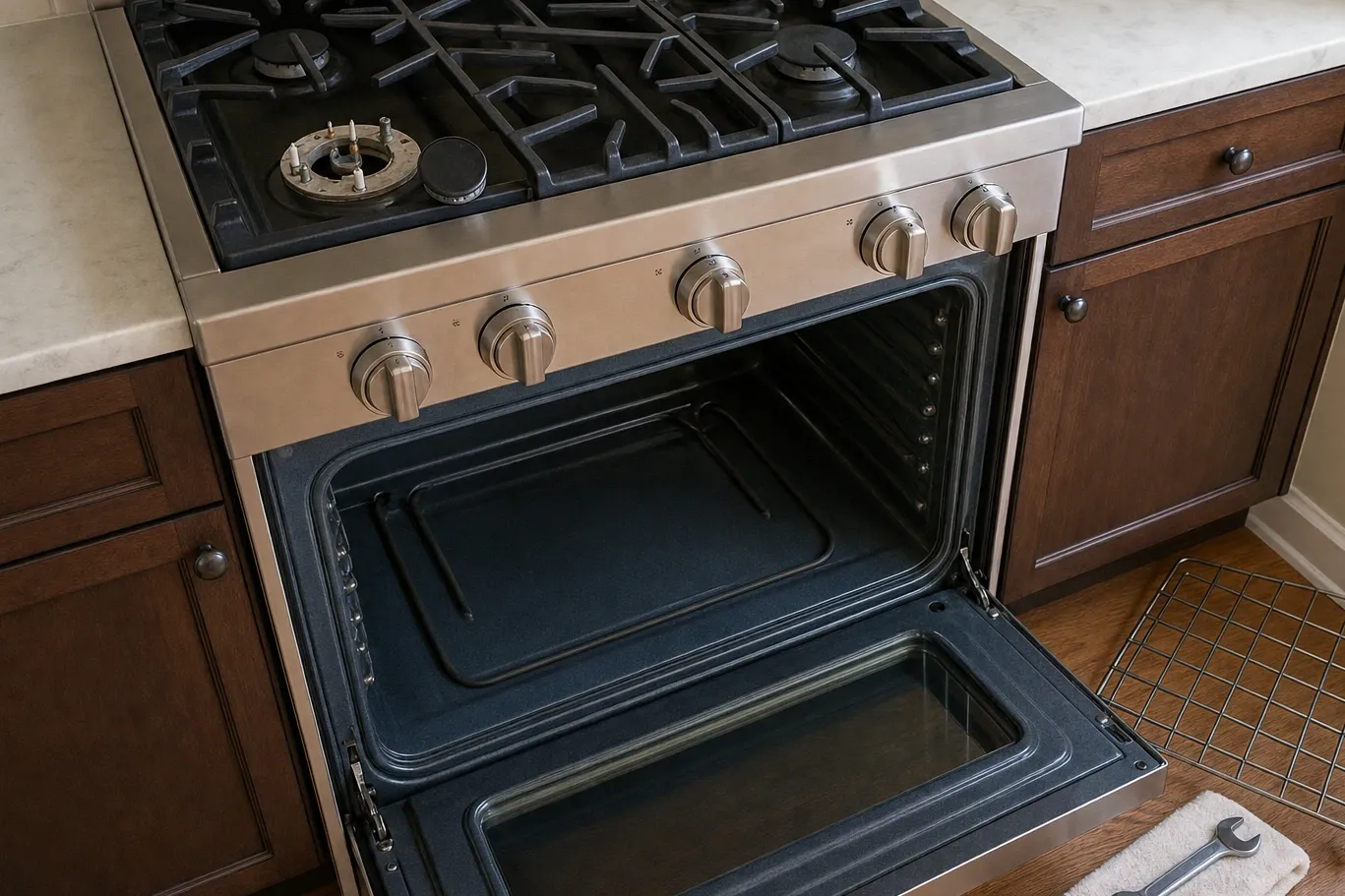
A sealed-burner Viking cooktop makes the same noise whether it is about to light or about to waste your afternoon: a fast, even tick from the spark module under the cooktop. When a burner catches, the ticking stops within two or three clicks. When it does not, the module keeps going until you give up and turn the knob off, and the question every caller asks is whether that means the range is broken.
Usually it does not. On this equipment, in this city, a burner that clicks without catching is a cleaning problem four times out of five, an electrode or switch two-part problem most of the rest of the time, and a genuinely dead spark module rarely.
What the clicking is, and what it is not
Behind the knob is a single stem doing two jobs at once. Turned to LITE, it lets gas through the valve and, in the same movement, closes the switch that wakes the spark module. From there the module pushes a high-voltage pulse out to every electrode on the cooktop, several times each second. An electrode is that small pin of ceramic and metal standing at the edge of the burner base, and the spark leaves its tip for whatever earthed metal is nearest — the burner cap, if everything is sitting where it should — across a gap of a couple of millimetres.
So the clicking is not the burner trying to light. It is the module doing its one job. The spark is happening whether or not gas is arriving and whether or not the spark is landing anywhere useful. That is why “it clicks, so the igniter works” is the most common wrong conclusion in the trade.
Three things have to line up in the same half-second: a spark of the right energy, in the right place, in a gas-and-air mixture that will take it. Diagnosis is nothing more than working out which of the three is missing.
The four faults that stop a burner catching
A fouled or wet electrode. Anything boiled over on that burner has run down onto the electrode. Sugar carbonises onto the ceramic and the spark then tracks down the deposit to the burner base instead of jumping the gap — you can often hear it, a duller and slightly irregular tick. Water is the same story in reverse, which is why a burner that worked before you cleaned the cooktop and not after is nearly always just wet.
A cracked insulator. The white ceramic sleeve is the only thing keeping that pulse from earthing early. A hairline crack, usually from a pan being dropped or from a cap seated crooked, sends the spark to the nearest metal at the base. The burner never sees it. Held up to the light, the crack is normally visible.
Blocked ports or a dust-packed venturi. Phoenix supplies this one for free. Monsoon dust is fine enough to get past a hood filter and settle in the burner’s throat, and the ports closest to the electrode are the ones that clog first. The burner then either refuses to catch at all or catches only on the high setting, which is exactly what people describe as “the simmer has stopped working”.
Gas that is not arriving properly. An orifice sized for the wrong fuel, a manifold pressure below spec, or a valve stem that has stiffened all present as a burner that will not take a spark. This is the group that a meter and a gauge settle in minutes and guesswork never does.
What is worth checking before you call anyone
Turn the burner off and let everything cool. Then, with the knob at OFF:
- Lift the cap and the burner ring and look at the electrode. If it is dirty, clean the ceramic and the tip with a dry toothbrush or a green pad — no water, no oil, nothing abrasive enough to score it.
- Look at the ports around the rim. Clear each blocked one with a straightened paperclip or a stiff bristle, never a drill bit and never anything that will widen it.
- Put the cap back squarely. A cap sitting proud on one side moves the earth point away from the electrode and can stop a burner catching on its own.
- Dry everything. If the cooktop has been washed in the last hour, leave it an hour longer.
- Try it again and listen. A crisp, even tick that lights within three clicks is a burner you have just fixed.
If you can smell gas at any point, stop. Turn the knob off, open a window, and ring the gas utility before anybody else — that is not a repair call, and nothing in this article applies to it.
When the clicking is a symptom of something else
Two patterns tell you the burner itself is fine and something upstream is not.
The first is clicking that will not stop when every knob is at OFF. That is a switch stuck closed or moisture bridging the switch contacts, and the module will keep firing until it cooks itself. Cut the power at the breaker and get it looked at rather than letting it run.
The second is a burner that lights beautifully and then drops out when the vent hood goes to high, or when the oven comes up to temperature. That is not ignition at all. It is a burner running at the edge of its mixture — a partly blocked venturi, an orifice out of spec, or low manifold pressure — and the extra air movement is only what pushes it over the line. Chasing the electrode on that fault gets you nowhere, which is why the first thing that goes on the range is a gauge rather than a screwdriver.
What a technician does that you cannot
The rest of it needs instruments. Electrode resistance and gap get measured rather than judged by eye. The switch is checked for continuity on both halves of its travel, because a switch that closes for the spark but not for the valve is a real and confusing fault. Manifold pressure is read at the tap against the rating plate for the gas actually supplied to the house, and the orifice is confirmed as the right one for that gas — a range moved between properties, or converted once and not documented, is a recurring find here.
And the spark module itself is tested by substitution, last rather than first. It is the most expensive part in the chain and the least likely to be the fault, which is the wrong way round from how it usually gets sold.
If the clean did not fix it, the useful thing to have ready when you ring is the model and serial number off the plate, which burner it is, and whether it improves with the cap off. That is normally enough to put the right part on the van before anyone sets off.
Follow-up questions
- The burner lights eventually if I hold the knob. Is that still a fault?
- Yes, and it is the most useful version of the fault because it tells you the gas is arriving and the spark is weak or badly placed. A healthy sealed burner catches within two or three clicks. Anything that needs five seconds of holding is a fouled or misaligned electrode, a cracked insulator leaking spark to the burner body, or moisture in the switch — all cheap to put right, and all of them get worse.
- Why do all the burners click when only one will not light?
- Because one spark module fires every electrode at once on most sealed-burner ranges. It is normal, it is not a fault, and it is also why "they all click" tells you nothing about which burner is in trouble. What matters is which one fails to catch and whether it improves when the cap is off.
- Can dust from a monsoon storm really stop a burner?
- It stops more burners here than any other single cause. The dust is fine enough to pass a hood filter, it settles in the venturi throat and around the ports, and the burner then runs lean or refuses to catch at the low end. Ports clear with a pin and a brush; a venturi packed solid needs the burner off the range.
- The knob turns freely and nothing happens at all — no click, no gas.
- That is usually the switch behind the knob rather than the burner. The spark switch and the gas valve are moved by the same stem, so a stem that has seized or a switch that has failed open takes both away at once. It is a part, not a clean, and it is not a job to leave running on a gas appliance.
Written by
Jonas Eriksson
Service technician — doors, hinges and alignment · 20 years in the trade
Checks how a door sits before checking what it is wired to. Hinges that have lost tension explain more running-time complaints than any control board ever has.