An 1890s Neighbourhood and a Modern Pro Range: Gas Supply and Circuits in Garfield Bungalows
In a Garfield bungalow the limiting factor for a professional Viking range is usually the original gas run, not the appliance: the kitchen sits at the end of a tandem row of rooms, as far from the meter as a 1920s plan allows.
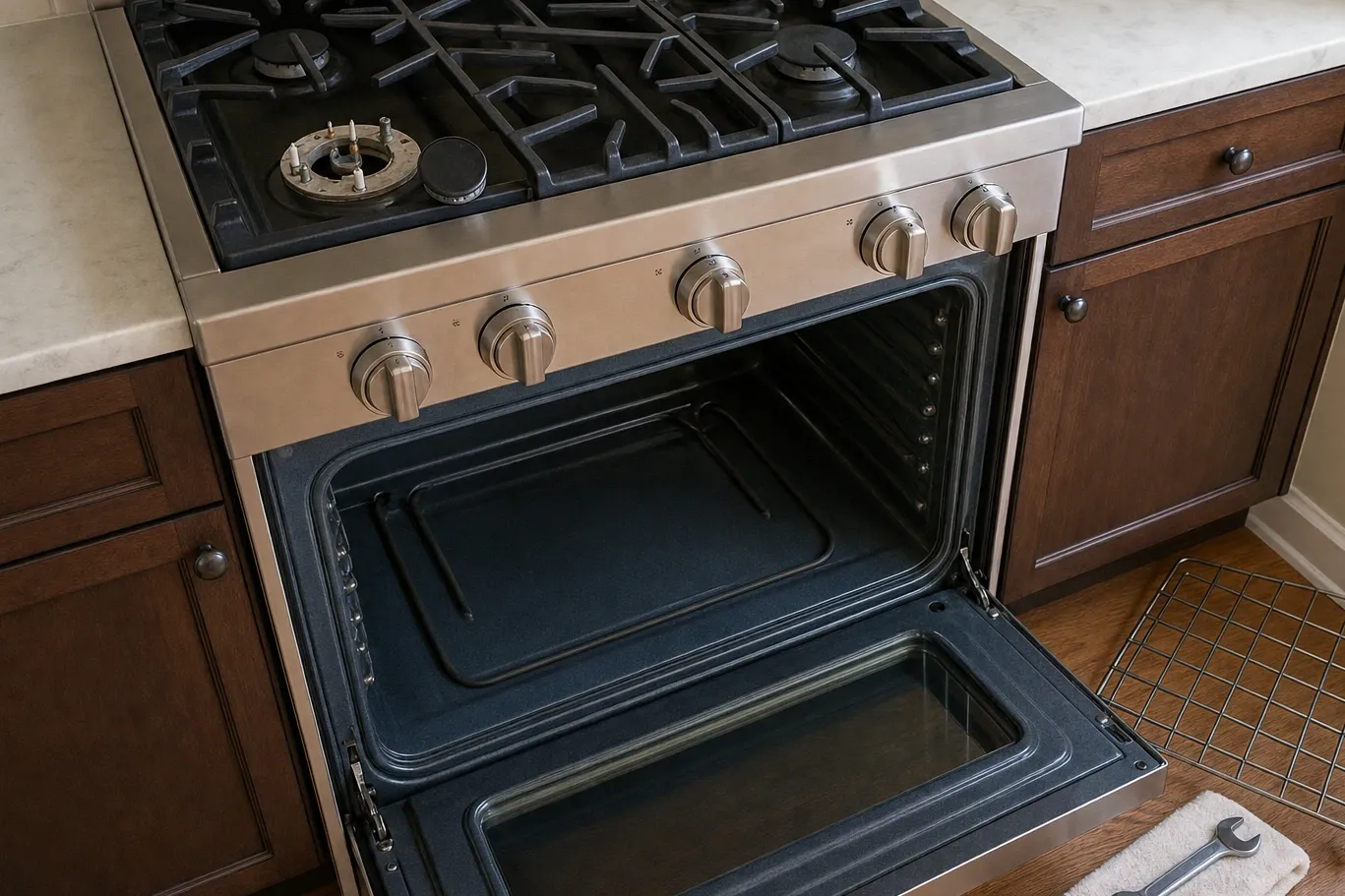
Garfield is the oldest surviving residential neighbourhood in Phoenix. John T. Dennis platted it as the Dennis Addition in 1883, the oldest house still standing — the Burgess Hadsell House at 1001 E. Fillmore — dates to 1893, and roughly 500 of the houses went up in the boom years between 1912 and 1929, about two thirds of the district’s present building stock. The National Register listed it in 2010. Most of it is modest Craftsman, Classic and California bungalow work, with the rooms laid out in two in-tandem rows.
Which means the kitchen is at the end of a row, at the back of the house, as far from the meter as any room in the plan. Everything that goes wrong with a professional gas appliance in one of these houses starts from that sentence.
What people here assume is wrong with it
That the appliance is faulty. A burner that sparks and sparks without catching, a flame burning orange and sooting the base of a pan, a simmer setting that drops out the instant the hood is turned up — three complaints, and the assumption behind all three is a bad igniter, a bad valve, or a range that was never any good.
The second assumption is that a historic house means historic wiring is the problem. Sometimes. But in a Garfield bungalow the electrical shortfall usually announces itself once, loudly, at installation, while the gas shortfall is subtle, intermittent and lives with the household for years pretending to be a component fault.
What is actually happening
A 1920s bungalow kitchen was piped for a four-burner stove of its era and an alcove sized for an icebox. A modern professional appliance asks for several times that gas input. The pipe that was adequate then is being asked to carry a load nobody imagined when it was cut and threaded.
Gas supply does not fail like electricity fails. There is no trip, no bang. What happens is pressure drop along a long, small-diameter run: the further the appliance sits from the meter and the more the demand, the lower the pressure arriving at the manifold. So the appliance works perfectly with one burner lit and starves progressively as more are called. Add a rear addition — most of these houses have one — and the run gets longer still.
Then there is the air side, which Phoenix contributes twice. A powerful hood in a small tight kitchen pulls the room negative, and a starved flame is the first thing to notice; that is why the simmer drops out when the vent goes to high, and why it recovers when a window is opened. And the summer dust storms load igniter tips, burner ports and cap slots with fine grit, which produces a grill or griddle section that stops lighting a week after the storm and had nothing wrong with it before.
Estrella and South Mountain houses hardly ever show the first problem — newer runs, shorter distances — but they get the dust just the same. Alhambra’s post-war block ranches sit in between: short enough runs, but often a kitchen updated one appliance at a time, with the gas load doubled and the piping never revisited.
The evidence, in the order we look at it
We reproduce the complaint under load before touching a part. One burner at full, then two, then every burner, then the oven called on top of that, watching flame shape at each step. A flame that is tight and blue alone and lazy and yellow at full demand has told you the answer in ninety seconds.
Next the pathway, not the appliance: meter and regulator, the diameter of the run, its length and its fittings, and every other gas appliance that has been added to the same branch since it was installed. In a Garfield house the honest measurement is often that the run cannot deliver what the appliance is rated for, whatever condition the appliance is in.
Then the hood test. Same load, hood off, hood at high, and a door or window cracked. If cracking a window fixes the simmer, the problem is make-up air and no valve replacement will help.
Only after that do we work the appliance itself: burner ports and caps cleaned and inspected, orifices verified as the correct ones for the fuel actually supplied, spark module and electrode tested, ground path checked, and the valves examined last, because they are the part most often replaced unnecessarily.
The fix that holds
If the pathway is short, the fix is at the appliance and it is durable. Clearing ports and caps of desert grit, replacing a cracked electrode, correcting an orifice that was never changed when the appliance was moved, and reseating a burner that has been sitting fractionally off its port — these hold for years.
If the pathway is the limit, the fix is a licensed plumber upsizing the run or the meter, and it is worth doing once and properly rather than chasing symptoms. We will tell you plainly which of the two you have, because selling a valve into a starved supply is how a customer ends up paying twice for a fault that never moves.
Make-up air is the third fix and the one most often skipped. In a small bungalow kitchen with a serious hood, a deliberate air path is not optional equipment.
Where to stop and call
Stop immediately for any smell of gas, for soot marks appearing around the appliance, or for a flame that lifts off the burner rather than sitting on it. Stop for repeated failures to light on a burner that has been cleaned, because unburnt gas released into a small kitchen is a different category of problem from an inconvenience.
Otherwise, cleaning caps and ports and clearing storm dust are reasonable homeowner work. Past that, a visit is $89, and it buys a decision rather than a guess. Igniter or burner assembly work runs $170 to $420, an oven thermostat or heating element $210 to $440, and a control board or touch panel $470 to $630. A dishwasher pump or control, if that is what came up while we were there, is $190 to $390.
(480) 605-0709 if you would rather describe it than type it. If your house is in the district, mention it — the pipe run is where we will start looking.
Follow-up questions
- Can a 1920s bungalow supply a professional gas range?
- Often not without work first. These kitchens sit at the end of a tandem row of rooms, about as far from the meter as the plan permits, and were piped for a stove of their own era. The appliance can be flawless and still starve, because a long small-diameter run cannot deliver what a modern unit asks at full demand.
- Why does the flame shrink when I turn the vent hood up?
- Because the hood is pulling the room negative and nothing has been provided as a deliberate replacement air path. Crack a window and repeat the test. If the flame recovers immediately, your problem is make-up air rather than the burner or the valve, and that is very common in small historic kitchens fitted with serious ventilation.
- A dust storm went through and one section stopped lighting. What now?
- Fine grit loads igniter tips, burner ports and the slots in the caps, so a section that lit perfectly the week before simply stops. Lift the caps, clean the ports and the electrode carefully, and get everything dry before refitting. If it still refuses after that, an igniter or burner assembly runs $170 to $420.
Written by
Jonas Eriksson
Service technician — doors, hinges and alignment · 20 years in the trade
Checks how a door sits before checking what it is wired to. Hinges that have lost tension explain more running-time complaints than any control board ever has.